What if the knock on the door from social services wasn’t the start of a forced eviction, but the beginning of a supported journey back to a safe home? For many residents across our county, the prospect of hoarding clearance social services Lancashire interventions brings a deep sense of anxiety and a fear of losing control over their own sanctuary. It is completely natural to feel overwhelmed by the thought of council assessments, especially when you’re already managing the complex emotional weight of hoarding behaviour which affects between 2.5% and 6% of homes in the UK.
We understand that you want a home that is safe and habitable, but you also need a process that treats your possessions and your history with the respect they deserve. This guide explains how Lancashire County Council’s safeguarding duties and specialist clearance teams work in harmony to provide a bridge between legal requirements and human compassion. You’ll learn about the Pan-Lancashire Hoarding Guidance, the role of the Care Act 2014 in protecting your rights, and the practical steps you can take to organise a discreet, gentle clearance. By understanding the multi-agency approach used in Lancashire, you can move forward with the clarity and peace of mind you need to reclaim your living space.
Key Takeaways
- Learn how Lancashire County Council’s duty of care under the Care Act 2014 focuses on safeguarding and support rather than simple enforcement.
- Understand how to navigate a hoarding clearance social services Lancashire assessment by building a collaborative plan that prioritises the resident’s wellbeing.
- Discover why recognising hoarding as a complex mental health behaviour is the first step towards a sustainable and compassionate solution.
- See how specialist features like unmarked vans and female-led teams ensure a discreet, gentle process that protects your privacy within the community.
- Gain clarity on the practical steps needed to transform a property into a safe, habitable home that satisfies all statutory safeguarding concerns.
Understanding the Role of Social Services in Lancashire Hoarding Cases
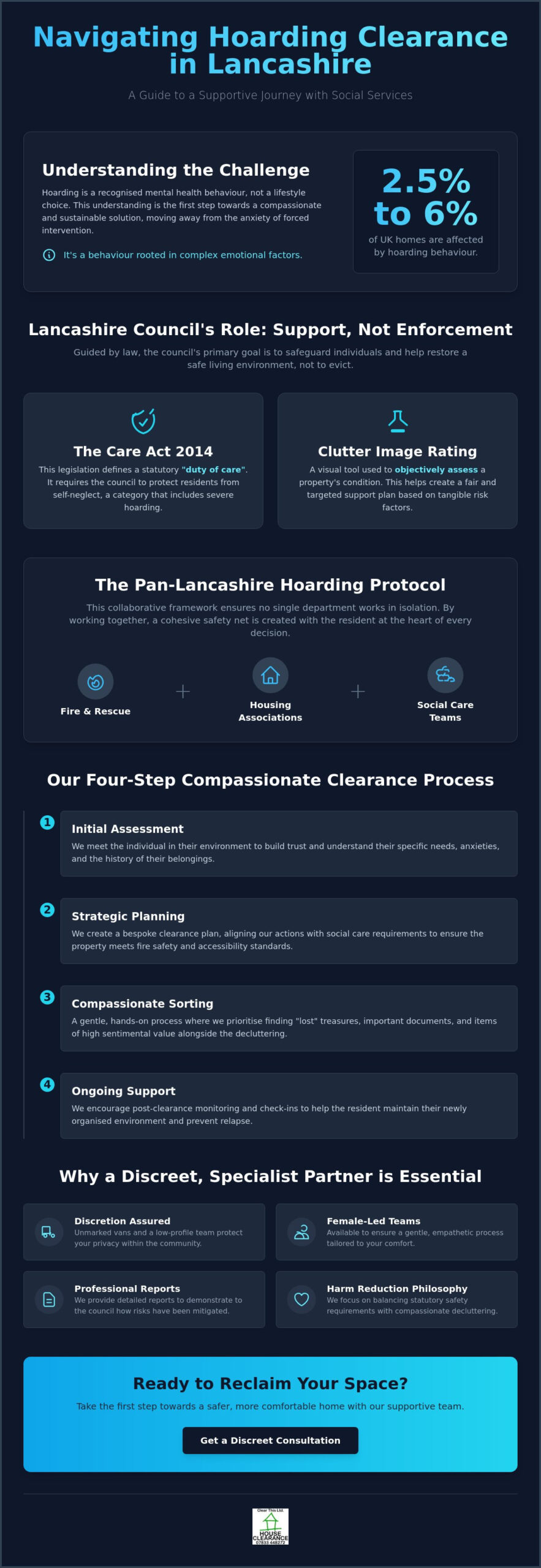
Lancashire County Council operates under a statutory “duty of care” defined by the Care Act 2014. This legislation requires local authorities to protect individuals from self-neglect, a category that often includes severe hoarding. When coordinating hoarding clearance social services Lancashire teams don’t simply see a cluttered room; they recognise a resident who may be struggling with their mental health. By Understanding Hoarding Disorder as a recognised psychological condition rather than a lack of organisation, social care professionals can offer support that focuses on the person’s long-term wellbeing. In communities across Chorley, Preston, and Blackburn, involvement often begins when a neighbour or health professional notices risks like fire hazards or restricted access. This multi-agency approach ensures that health, housing, and social care professionals work together to provide a safety net for the individual.
When does Adult Social Care get involved?
Social care typically steps in when a property reaches a level that impacts the safety of the occupant or the wider community. They often use a “Clutter Image Rating” scale, which is a visual tool that helps assess the severity of the situation objectively. It’s important to remember that their primary goal isn’t to force an eviction or cause distress. Instead, they aim to facilitate a hoarders house clearance that restores a habitable environment. This process is designed to support the individual’s independence, ensuring they can continue living in their own home safely and with dignity.
The Lancashire Multi-Agency Hoarding Protocol
The Pan-Lancashire Hoarding Guidance ensures that no single department works in isolation. This protocol brings together the Fire and Rescue Service, housing associations, and social care teams to create a cohesive support plan. This collaborative framework ensures the resident remains at the heart of every decision. It prevents the process from feeling like a cold, administrative task and instead turns it into a structured, supportive effort to improve quality of life while satisfying essential safeguarding requirements.
Navigating the Hoarding Clearance Process with Statutory Support
The physical transition from a council assessment to a safe, habitable home requires a structured approach that prioritises the individual’s mental health. This journey usually begins with building a foundation of trust, ensuring the resident feels heard rather than judged. Once a rapport is established, we create a bespoke clearance plan that directly addresses the safeguarding goals set out by Lancashire authorities. By working in stages, we help reduce the feeling of being overwhelmed, turning a daunting task into a series of manageable steps.
The physical work follows a methodical four-step process:
- Initial Assessment: We meet the individual in their environment to understand their specific needs, anxieties, and the history of their belongings.
- Strategic Planning: We align our actions with social care requirements to ensure the property meets fire safety and accessibility standards.
- Compassionate Sorting: This is a gentle, hands-on process where we prioritise finding “lost” treasures, important legal documents, and items of high sentimental value.
- Ongoing Support: We encourage post-clearance monitoring and check-ins to help the resident maintain their new environment and prevent a relapse.
Assessments and Safeguarding Reviews in Lancashire
During a home visit in Blackpool or Wigan, a social worker focuses on practical risks like blocked fire exits and sanitary conditions. Providing a detailed professional clearance report can be an invaluable tool in demonstrating to the council that these risks have been mitigated. If the situation has been triggered by the loss of a loved one, integrating a bereavement house clearance service approach ensures the emotional weight of the transition is handled with extra sensitivity.
Balancing Safety with Compassionate Decluttering
Successful hoarding clearance social services Lancashire cases often rely on a “harm reduction” philosophy. This means we focus on making the home safe and accessible without stripping away the resident’s sense of security. Following NHS guidance on hoarding, we understand that items often carry significant emotional value. We work at a pace that respects this attachment, ensuring the removal of items is a collaborative choice rather than a forced action. If you’re feeling unsure about how to start this conversation, our team is here to offer a listening ear and gentle advice.
Why a Discreet Specialist Partner is Essential for Long-Term Success
Choosing the right partner for hoarding clearance social services Lancashire interventions isn’t just about moving physical items; it’s about protecting a person’s spirit during a vulnerable transition. We’ve found that a female-led team often provides a softer, more intuitive approach that reduces the confrontation often felt during these sensitive times. This trauma-informed method focuses on the individual first, ensuring that every possession is handled with the dignity it deserves. By shifting from a crisis state to a managed home environment through a professional hoarders house clearance, we create a stable foundation that satisfies social care requirements whilst providing genuine relief for the resident.
Beyond the emotional support, we prioritising ethical disposal and recycling as part of our community-focused mission. Being a responsible partner means ensuring that items are handled with care, with as much as possible diverted from landfill to support local sustainability. This integrity-led approach reflects our deep respect for the Lancashire environment and the families we serve, ensuring the process is as kind to the planet as it is to the person.
The Benefit of Unmarked Vans and Private Clearance
In close-knit Lancashire communities like Leyland or Clitheroe, privacy is frequently the primary concern. The sight of a liveried van can spark unwanted neighbourhood gossip, adding unnecessary stress to a family. We use unmarked vans to ensure our presence remains quiet and professional. Whether we are providing a house clearance service in Preston or a smaller village, our commitment to discretion helps maintain the resident’s dignity and standing within their community.
Moving Forward: Maintenance and Support
A successful clearance serves as a vital “fresh start” for both the individual and the social services team monitoring the case. It clears the physical path for therapists or support groups to begin their work. We recommend looking into local Lancashire-based resources, such as the Lancashire Safeguarding Partnership or specialist hoarding support groups, to help manage the psychological aspects of the behaviour. This ongoing care, combined with a safe living space, offers the best chance for a sustained and positive future.
Reclaiming Your Space with Confidence and Care
Managing a home under the guidance of local authorities is a significant step, but it is one you don’t have to take alone. By understanding the collaborative relationship between hoarding clearance social services Lancashire and specialist teams, you can transform a source of anxiety into a manageable plan for the future. We’ve seen how a structured, gentle approach satisfies safeguarding requirements whilst prioritising the emotional wellbeing of the resident. This process is about more than just clearing space; it’s about restoring safety and peace of mind.
Our female-led team brings a unique depth of empathy to every situation, ensuring that your history and belongings are handled with the utmost respect. We understand that privacy is paramount in our local communities, which is why we always use unmarked vans to maintain your discretion. Combined with our commitment to ethical disposal and recycling, we provide a service that is as responsible as it is kind. If you are ready to begin this transition, we are here to support you at a pace that feels right for you. Please contact Clear This Ltd for a compassionate, discreet hoarding clearance quote in Lancashire and take the first step towards a brighter, more manageable home environment. There is always a path forward, and it starts with a single, gentle conversation.
Frequently Asked Questions
Does Social Services pay for hoarding clearance in Lancashire?
Lancashire County Council doesn’t typically have a fixed budget to pay for the physical labour involved in a clearance. Support is provided through a broader assessment of care needs under the Care Act 2014, but the financial cost of the work usually remains the responsibility of the property owner or tenant. In specific cases where there’s an immediate safeguarding risk, some financial assistance might be explored through local grants or benefits, but this is decided on a case-by-case basis during your assessment.
Can Social Services force a house clearance if the person refuses?
Authorities always prefer to work collaboratively, but they do have legal powers to intervene if a property poses a significant risk to life or public health. Under the Mental Capacity Act 2005 and various Public Health Acts, councils can seek court orders for a hoarding clearance social services Lancashire intervention if the resident is deemed to lack capacity or if the home is a severe fire hazard to neighbours. These measures are only ever used as a last resort after all attempts at gentle engagement have been exhausted.
How long does a specialist hoarding clearance typically take?
The duration of a clearance depends on the density of the items and the size of the property, but most specialist projects are completed within two to five days. We move at a steady, methodical pace that allows for the careful sorting of belongings rather than a rushed approach. This deliberate speed ensures that important legal documents and sentimental treasures are recovered whilst still meeting the safety deadlines often set by social care or housing associations.
What happens to the items removed during a Social Services-led clearance?
Items removed during a professional clearance are handled with a deep commitment to ethical disposal and environmental duty. We aim to recycle or repurpose as much as possible, ensuring that only genuine waste is sent to landfill. If items are in a safe and sanitary condition, we can often facilitate donations to local Lancashire charities, ensuring that the process remains community-focused and respectful of the items’ potential future use.

Article by
Jennie
Jennie is the owner and director of Clear This Ltd. She follows each job through from quote to completion.